A peaceful protest occurred in Accra a few weeks ago. It lasted for 3 days. It went differently then what was expected. Several protests have occurred afterwards by different groups. You may or may not have heard about it. This got me thinking about how we all can show up more for the solution.
The initial peaceful protest was focused on economic hardships in Ghana. Becoming a space for Ghanaians to speak out on their frustrations. It was unfortunately met with disrespect and violence from Ghana’s police following “orders.” The local newspapers did not report on the incident, as if it did not happen.
Please don’t give up. This shows you have a voice. Your concerns are valid. You demonstrated something monumental.
I’m always encouraging you on here to think for yourself. This is a great opportunity to do that. Please know that I do not mean any disrespect or harm. I feel this is a chance to be open to learning and understanding.
To learn more about the demands and progress of the Occupy Julorbi House movement, click here.
I hear some of you. Why protest? What difference did it make? True. This needs to continue to be strategic. The demonstration was a success because you showed up and took up space. Next, to play the next level of this game, you need to understand that pulling heartstrings will not give you the justice you deserve. Complaining that your leaders and elite don’t care is a waste of your energy. Leaders who do not have a solid team and do care about their people are assassinated or silenced. You know this too well.
As funny and sad as the tweets are, it can be tricky to boycott businesses you are not a regular customer for. So, be smarter with your big hearts. I know you already watched House of Cards and read The Spook Who Sat By The Door. In other parts of the world, lobbyists are the next play in this game. How can that be implemented here? Private enterprises hold a lot behind that. Could that sufficiently translate here?
I’ve had people ask me so what next after the protest. And nothing will change after this protest so why waste time. Ghana won’t get better after one protest or even two. But we have to start from somewhere and let our leaders know they’re here to serve us and make things better,…
I’m aware my community on here is diverse. So, I trust we can cover all angles on this collaboration. Reflect on it. No need to post the blueprint here. This should be part of the reason why so many different people are in and continue to move to Ghana. We all need to be including provisions to this solution in what we are cultivating here.
Not to dismiss anyone’s initiative, but what is the point of all this healing and investing if we are not closing the gap on these discrepancies? What good is all of your real estate potential, tourism attractions, economic summits, trade expos, academic seminars, viral dance videos, and Detty December Citizens if the location is this hostile to the basic well being of its people? What is the point of the wide spectrum of passport privilege, currency privilege, tribal privilege, and family name privilege that exists here, if we are not leveraging it for collective winning?
Ghanaians don’t want hand outs, we simply want an enabling environment to do business, earn an honest living and thrive. Ghanaians want to live and die in dignity. we’re not asking for much #OccupyJulorbiHouse
you should know that many of our diasporan brothers and sisters love that the exchange rate gives them a sense of more wealth in ghana. to feel like they belong to an elite class once home creates a feeling of superiority.
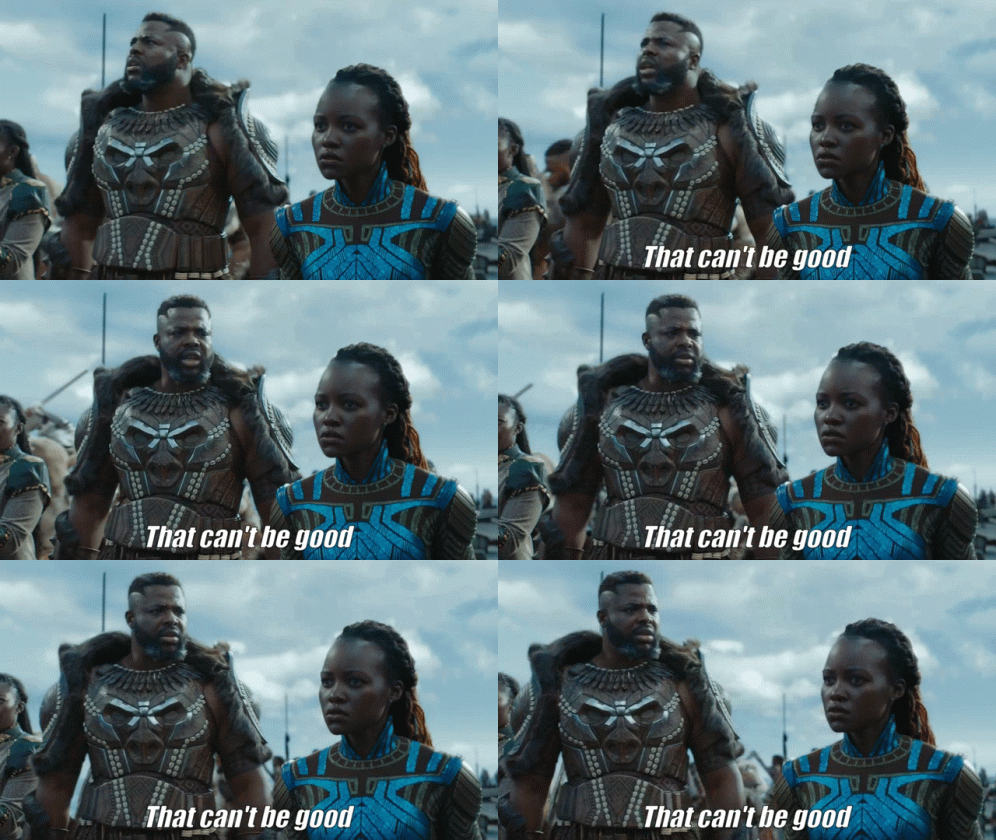
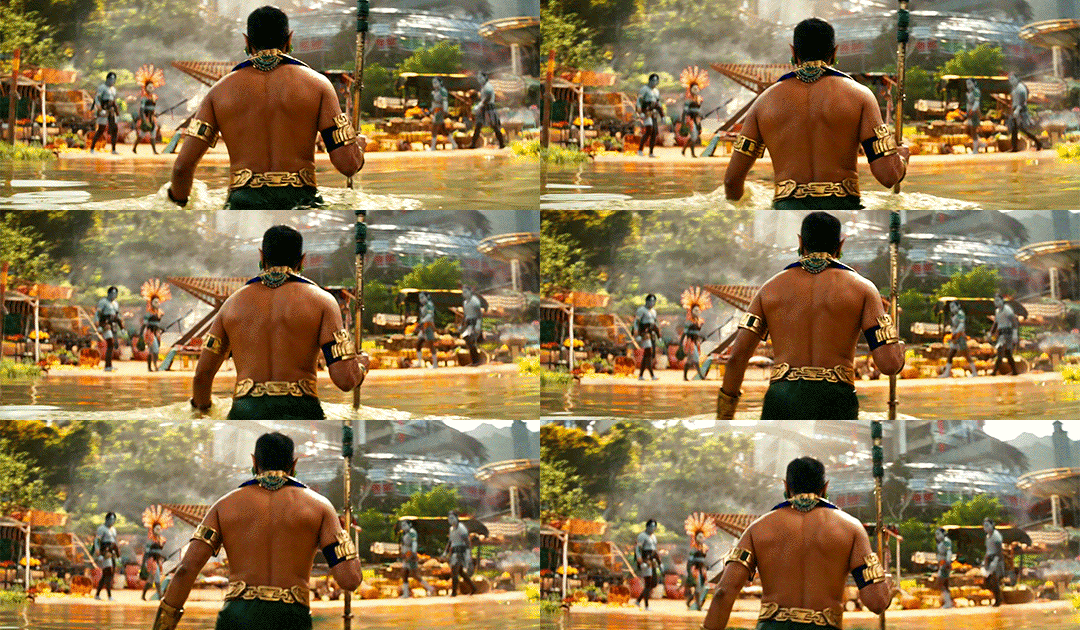
I know these are only words. I know I can’t call the Avengers to help. I did mention this to Wakanda, but they are busy swimming at the moment.
Within a year of moving to Ghana, my beacon of hope for all forms of freedom, Pan-Africanism, Black liberation, World equality, and collective healing evolution faded. Seeing what you did at this initial protest reignited that beacon of hope for me. The way you all committed to your mission for peace and took care of each other. In spite of being so despicably disrespected and hurt. You did not bend down to “their” level. I hope you understand the magnitude of this. You should be proud.
🚨 This is not a criticism, merely an appendage of my tweet, from yesterday, about 𝐡𝐢𝐠𝐡 𝐩𝐫𝐨𝐟𝐢𝐥𝐞 journalists and media; and how they behave in the face of headline national issues.
🇬🇭 50 years from now, a young person may enter Ghana's news archives and look for front… pic.twitter.com/AaxIyptRdA
At the moment, neighboring countries have resorted to military coups to voice their frustrations. I’m cheering for their justice too. I hope and trust they have a plan beyond pushing out the bully. I understand Ghana already did this and today some are still questioning whether or not that provided the progress you deserve. These protests show you don’t need to repeat that. You can lead by example with a different method.
At the moment, the only reliable account of the inital protest is this special episode of the Sincerely Accra podcast. Listen well. Also check out their Twitter Space on that day.
To continue to be up to date on conversations and progress, check out Julorbi Radio below.
As always, the question is “what next?” Here is a tool to explore: the Social Change Ecosystem Map. This can help you gain more insight on where your values and gifts can contribute to social change.
So, my fellow diasporans who ask why Ghanaians “are not angry enough.” Do you now see the cards they are dealt? The police were equipped for war against citizens holding placards. The local media under reported or did not report at all. Some people’s jobs were threatened if they participated. The puppet strings are more complex then you may realize.
Now, my fellow Ghanaians, regardless of which bubble you exist in, please don’t give up on Ghana. Be wise, disciplined, and strategic. Be peaceful and responsible. Avoid distractions and detours. You deserve justice. You deserve more.
To everyone who was involved in-person, virtually, and/or in spirit, please take care and be safe.
I feel we have had more than enough time to reflect, marinate, and embody our thoughts and feelings towards the direction Wakanda is going. Did the movie Black Panther Wakanda Forever give what it needed to give?
In this episode, we share how we felt about the movie and what themes stood out to us.
Which team would you choose to win this game? Team Wakandans or Team Talakans? Or Team 3?
One theme that stood out to me in this movie was the focus on the two most powerful groups on the planet fighting each other for 2 hours and 41 minutes over damage and chaos caused by a bully, colonizer, or institution of bully colonization. I feel this dynamic reflects reality in the two extremes we follow historically to steer change and playing the bigger game. Let’s unpack that.
Team Wakandans’ mode of operation is to be the bigger person. The noble one that navigates their decisions for the higher good. This is great and admirable, but can possibly hinder progress if done narrow mindedly. For example, Wakanda’s previous decision to set up an outreach program in Compton, California is wonderful. In addition to that, why could we not also set up an outreach program next door in Niger? That could also help balance out the exploitation bases there. Another good example is the scene at the UN meeting in this movie. The Queen of Wakanda is invited and two particular countries, the US and France, hold the majority of the dialogue in the scene. They insist the world is not safe if only Wakanda has access to vibranium and it is in the best interest of international policy to give it to the US and France. However, behind the scenes, they had already deployed their agents to try to steal the vibranium. Does this sound familiar?
Let’s connect some dots. Is it too much of a stretch to note that vibranium rhymes with uranium? Or that the US and France are currently in Niger playing the international diplomacy violin for the cameras and causing the proxy chaos behind the scenes for access to uranium? What role is ECOWAS playing? Are they showing up like Wakanda, calmly refusing to participate in the destruction of their neighbors while protecting their resources and people? Or are they volunteering to be played?
But, back to the movie. Team Talakans’ mode of operation is to be the only person standing…or swimming. When the opponent goes low, the Talakans will show you how low they can go. This influences their decisions to mostly drown first and don’t ask questions later. Similar to Wakanda, their heart is in the right place and they are valid in protecting themselves the way they do. Actually, I felt they have a better sense of what bullies are capable of compared to Wakandans. For example, when the King of Talakan was asked why he chose not to kill Shuri and destroy Wakanda, because he could have, his answer reflects a lot of wisdom. He understands the game, or scam, people on land play. He notes that Wakanda is the most powerful group of people on land, but they have no ally and obviously do not fully grasp the games others are playing. One day, Wakanda will need Talakans help. Talakan will give that help…probably for a price. It’s giving Godfather. It’s giving Mafia chess moves. It’s giving ancient Egyptian empire has entered the chat. Is it clean? Probably not. But is it effective? Possibly.
Now, let’s connect some more dots. Do you see how these two teams represent previous attempts to pushing for change and protection? One side wants to use reason and fairness. Wants to discuss and make arrangements. The other side wants to take back its power by any means necessary. Wants to protect its own by all costs. Because all their lives they had to fight. Two extremes that have played out throughout history all over the world. And yet, these two extremes have been played or blindsided each time by an outsider bully looking to distract and extract. That is something I appreciated about this movie. This dynamic is not only focused on Africa or Black vs white. Latin America, the Islands, Asia, and the Middle East have also experienced variations of this. All dealing with similar groups of bullies.
If this same game has been played for so long, why does everyone continue to play the same role? That is what I found fascinating. At least in the way I saw the movie. Wakanda and Talakan are powerful, but they are playing as pieces on the board of the game. While the bully is sitting at the table moving the pieces. Regardless of how strategic Wakanda and Talakan try to be, or how much effort, resources, or sacrifice they give, they can only see and fight what is in front of them, which is placed on the board by the bully.
Which team do you think can win at this game? Or, could we have a third option? Team 3 could leverage the combined strength of Wakanda and Talakan, but also be smarter to either be 10 steps ahead of the bully or completely transform the board game.
What do you think? Let me know in the comments. Again, remember, we are only talking about a movie. Based on a comic book and fantasy. None of this is real.
If you enjoyed this podcast episode, remember to subscribe here. We are streaming on Spotify, Afripods, Google, Apple, and Pocketcast.
If you want to know why something is happening, follow the money. To further the discussion to heal the distance between Africa and its Diaspora, let us go over the historical and current economic oppression that influences and determines the Black experience.
In this video and post, I am focusing on Black America and Ghana. For Black people outside of America and Ghana, please do not feel isolated or excluded in this conversation. The point is for all of us to win. Understanding how we can strategically do that is key. As you read further in this post, I widen the focus to other parts of the world.
Let’s dive deeper. Starting with economic oppression and Black America, there are two layers to this agenda: the wealth gap and the income gap. The wealth gap was created by the exploitation of free labor from Black slaves, passing down of profits from that exploitation, and destroying and stealing from Black businesses.
The history of slavery in America is diluted and distorted in American history. The wealth gap began with cotton. America’s first big business, which pushed it to be the leading economy in the world, revolved around slavery. At one point, American cotton made up two-thirds of the global supply of cotton. This was all off the backs of slaves. Americans became millionaires off the bleeding backs of enslaved Black people. This is also where police brutality began. Aggressive and barbaric white “supervision” was used to return runaway slaves to the plantation while violently and brutally questioning the work and movement of slaves. This Vox article gives more details on how slavery became America’s first big business.
Like I mention in the video, there are two historical massacres that are referred to as the illustration of why telling Black people to pick themselves up from their bootstraps is not valid.
The Tulsa Massacre in 1921 occurred in Tulsa, Oklahoma in the Greenwood District, which was also known as Black Wall Street. It was an affluent Black American community that included thriving and peaceful Black businesses and residential areas covering 35 city blocks. The incident that started the massacre is still surrounded by rumors around what happened when Dick Rowland, a Black man, and Sarah Page, a white woman, stood in an elevator. A white mob formed reacting to this rumor that was further embellished as it spread through the town. Rowland was arrested and held at the police station. The mob outside was met with a group of concerned Black residents who understood that Rowland was in danger of being killed by either law enforcement or this white mob. This response added to the rumors that spread among the white mob pitting for a race war. The white mob grew in size and hate. They proceeded to burn and destroy Black Wall Street, leaving around 10,000 Black Americans homeless and murdering around 300 Black Americans. The Tulsa Historical Society and Museum have archived the details of the Tulsa Massacre through documents, photos, and audio on their website. They also provide a free exhibit.
The Rosewood Massacre in 1923 occurred in the predominately Black town, Rosewood, in central Florida. It also was instigated by an alleged rumor that a white woman was offended, in this case sexually assaulted, by a Black man. The white mob that responded to this acted on further embellished rumors to burn the town to the ground and lynch / murder any Black man they could find. Again leaving those who survived homeless. More details are in this Black Past article.
The income gap continues through occupational segregation. Let’s go over some numbers. In 2018, 20.8%, which is 8.9 million, of Black America were living underneath the poverty threshold, being the second largest group in America living in poverty. (Source from Talk Poverty) The overall largest group is Native Americans at 25.4%. Like I mentioned in the video, Black people in America got the shorter end of the stick and Native Americans did not get a stick at all. Systematic inequality cannot continue to wipe them out either. Let me know if you would like to learn more about the Native American experience so I can direct you to the voices you need to listen to. Regarding unemployment, in 2018, the overall rate was at 3.8% and the Black rate was 6.5%. In 2020, the overall rate is 13.3% and the Black rate is 16.7%. America has the biggest incarcerated population in the world. Prison policies and reform has more depth than a few percentages could show. This report gives more details on the issue of mass incarceration in America. The income gap is not only maintained by unemployment. There is an additional layer with wages. This article breaks down how the wage gap is widening further. For more insight, read this report on systematic inequality and economic opportunity.
When we talk about systematic racism and systematic inequality, these numbers are part of the picture. One cannot “catch up” when the game is fixed or when the goal post continues to be moved. The gap is not actually influenced by the mask of education, home ownership, or job title. The gap is only influenced and maintained by the deliberate effort to keep the gap. This article from CityLab about why we can’t close the racial wealth gap has some good insight. This is part of why it is so exhausting to be Black in America. Always working hard and following the rules accepting that you will always have to tolerate less in every industry, field, interaction, and experience.
This is also why America always starts sweating when the conversation about reparations comes up. It is not because it is impossible to calculate the wealth Black America created and never benefited from. It is not because Black America is living so much better now compared to the 1800s or 1960s. It is because America prefers to drag its feet. It is because America prefers to do everything but what was asked for, like painting Black Lives Matter on a street, manufacturing band-aids that match brown skin, and kneeling while wearing cloth that looks like Kente cloth.
How can we learn from this? For the first time in a while, Black America used its purchasing power as an effective tool and Black-Owned businesses made millions of dollars over night. This is a good start. How do we take this further?
Now, let’s talk about economic oppression and Ghana. When I compare what was happening in Ghana with the same historical dates I listed above, I see there is a lot Africa’s people, in and out of the continent, can learn from to heal the distance and enhance the link.
In the 1860s, which was during the height of the cotton empire in America, the export of slaves was gradually diminishing. Even though the import of slaves to America was outlawed in 1808, the demand for slave labor continued after that. Later, Ghana experienced a shift as colonizers pivoted to competing with each other for colonial territories. During this time there were a variety of alliances and struggles for power, including the Ashanti-Fante War and the Anglo-Ashanti Wars. The latter wiped out different levels of British forces.
The debate as to whether Africans sold Africans into slavery is an interesting one. I have noted Africans rebutting that there is no evidence that a sale transaction occurred. I have noted Black people outside of Africa express suspicion on whether Africans were sold or stolen. Some argue that trying to discuss whether Africans sold Africans is like discussing black on black crime, which is a distraction from the movement. To me, it sounds like both discussions trigger people in different ways. I believe in holding each other accountable, which includes looking in the mirror and reading real history. The primary point is to avoid repeating history. Stop trying to distance yourself from the problem. We need to do better.
British authorities in the 1920s in Ghana adopted a system of indirect rule. Even though they put traditional chiefs in position of local authority, they took instructions from their British supervisors. During this era, transportation, water supply, public buildings, schools, prisons, hospitals, and other services were developed by colonial rule and African hands. Ghanaians also assisted Britain in World War I and World War II. A national conscious, which lead to independence, developed after WWII when veterans and the growing educated population no longer were satisfied with the humble position colonial rule kept them in. In some respects, Ghana was lucky compared to other African colonies. They did not experience limbs being chopped off, like Belgium rule in Congo, or complete destruction, like French rule in Algeria. However, one could analyze a wealth gap in how much was extracted from Ghana during this time.
Before I fast forward to the income gap of today, let’s pause here. If we focus on the historical events listed above for both Black America and Ghana, what do you see? Black people in America had a different experience with white people compared to Black people in Ghana during that time. Both set of colonizers utilized economic oppression, but in different ways. I feel this needs to be understood by Africans and Africa’s diaspora. This might be the reason why there is a sense of urgency to fight the power on one end and a sense of confusion and no urgency on the other. Remember, colonizers do not want us to be on the same team. I feel education has a role to play in this too. When I speak to Ghanaians about colonialism and Ghana’s relationship with England now, I do not pick up a sense of animosity or disdain. The narrative is not focused on exploitation, but rather how the British enhanced Ghana, historically speaking. Like I noted above, development did occur during colonial rule. Also focus on the fact that British rule had authority over education and implemented the British educational curriculum in Ghana. Making sure the Ghanaian population learned British history under a British lens, it is no surprise the British continued to frame themselves as a hero. This is similar to the American education system, which continues to frame the founding fathers and corporations as heroes. However, Black Americans have a different narrative when they speak about slave masters, Jim Crow law, and police brutality. Black British and Black French also have a different narrative when they speak about their experience with colonizers, which does include police brutality, economic oppression, and pushing statues back into the sea. I do not have the answer yet, but this disconnect should not be dismissed nor should it allow us to create more barriers between us.
Fast forward to the income gap of today in Ghana. In 2016, 56.90% of Ghana’s population was living underneath the international poverty threshold. In 2018, the unemployment rate in Ghana was 4.16%. There is a lack of transparency in the value of labor and skills in Ghana. This is why the numbers, which are primarily calculated and reported on by NGOs and international corporations, may not always add up. The focus of these numbers are primarily on national policy, like this report on Ghana’s poverty rate and inequality. There is a discrepancy between what Ghanaians are paid and what expats are paid in Ghana. There is inequality between what women are paid and what men are paid in Ghana. More details on this inequality are analyzed in this Oxfam report. As development continues, the gap between the rich and poor continues to widen.
These numbers and lack of numbers is part of the picture. This is why the sense for most in Ghana is that nothing you do will really change the bigger things that keep your life the way it is. Some still spend half the day without electricity. The floods, that could be prevented, still kill and displace people every year during rainy season. This supports the assumption that big money only comes from abroad or corruption, not real work. When you compare this to how many foreign companies are making real profits in Ghana and taking it outside of Ghana, like this company producing organic bananas, I have to wonder if this attitude is systematic to reduce competition.
How do we learn from this? There are plenty of Black owned businesses in Ghana and Africa. There is a strong purchasing power in Ghana and Africa. However, there is still a mix-match. How can we fix it?
How do we learn from how economic oppression has been utilized against us to effectively protect what we build? On a people, corporate, and government level. How do we prevent our efforts from being destroyed by those who want to maintain the status quo? Let me know what you think.
The energy we are feeling right now is a golden opportunity. The shift and change is possible, if we continue speaking up, evolving, holding each other accountable, and making a difference. Below are more resources for you to continue supporting Black content and businesses.
Also, feel free to connect with me on Instagram, Twitter, and Facebook. I love hearing from you.
Freedom Agenda
Black Owned Apps
JoinMi – safe space for HBCU students to converse about concerns and life.
Gbook – e-commerce platform for students to buy/sell products and services.





 Dagny Zenovia